 Megan Slattery Staff asked 10 years ago
You all know the importance of adaptations for the survival of plants and animals i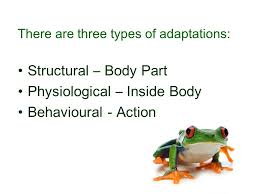 n different environments. We have spoken about the words ‘structural’ and ‘behavioural’ in class. I would like you to use your research skills to find out what these words might mean in relation to adaptations.
Demonstrate your understanding of the difference between behavioural and structural adaptations by recording your own definition of each and support it by at least two examples.
 Sophie answered 10 years ago
Behavioural adaptions are things that the living things do physically. eg.A behavioural adaption for a bear is hibernation.
Structural adaptions are features of a living thing. eg.feathers on a bird, and trunk on an elephant.
Hannah C-F :) :) :)!!!! answered 10 years ago
Structural adaptations are physical changes to parts of an animals body that help it survive. e.g. a chicken’s beak helps it pick up seeds to eat, a bird’s wings enables it to get around by flying.
Behavioural adaptations are how an animal acts when faced with every day tasks. e.g. owls are nocturnal so they are protected by the night from their predators, moose migrate in search of food.
Thanks for reading:)!
Wk 6 question response!!!!!!!!!!
Hannah.M answered 10 years ago
Structural adaptations are physical changes to parts of a living thing that help it to live and survive. E.g. A tigers stripes help it to camouflage, and a wolves fur shed and doesn’t shed depending on the season/weather.
Behavioral adaptations are how a living thing acts in it everyday life. E.g. Bears hibernate when it’s Winter, and squirrels collect food when it’s spring getting ready for Autumn and Winter.
Della answered 10 years ago
The word behavioral in relation to adaptation means the actions or the way the plants or animals react to their environment and where they live.
The word structural in relation to adaptation means the special features that help them get food or to protect them self in a way other animals doesn’t.
My two example for behavioral adaptations are:
Grey Whales migrate from the freezing Artic Oceans, to the warm Coast of Mexico.
Chameleons are able to change colour, to the colour and the pattern of their surroundings.
My two examples for structural adaptations are:
An Eagle has sharp eyesight, feather, sharp claws called talons and a sharp hooked beak.
A rabbit can change colour when it is a new season.
Anonymous answered 10 years ago
Week 6 Coby: structural means whats on their body to help them survive. Like a kangaroos tale that helps them balance. Or polar bears feet that helps them walk in the snow. behavioral is the way there behavior adapts like. lions golden brown hair makes them blend in with their surroundings.lions can run up to 30mph but for only short distances. their speed helps them get food.
Mollei🤓😀 answered 10 years ago
all organisms have a structural way to survive. Some adaptions are structural.Structural adaptations are physical changes to parts of a living thing that help it to live and survive. behaveriral adaptions mean, it means that, how organisms survive in the climate/season. e.g a salt bush survives only in the heat, because it doesn’t need watering or a cold climate/season.
TaraIsAwesome:) answered 10 years ago
Structural Adaptations are physical features e.g A Bilby’s long snout that help the animal to survive, the Bilby’s long snout helps to to smell things better
Behavioral Adaptations are the things that organisms do to survive e.g bird calls and migration, and bears hibernating.
That’s my answer to week 6’s question! 😛
Maya is awesome😎 answered 10 years ago
Structural adaptation:
structural adaptation ,Means for the animals body to do something that either, keeps them cool, wars them of predators or to keep predators away e.g
a kangaroos ears help it cool down by…….
so if a kangaroo moved to a very cold environment they would physicals have to find away to keep warm.
Behavoiral adaptations:
behavoiral adaptatino are thing the animal itself can do to adapt, e.g
birds hide from predators high up in trees
So if a bird moved to a place with no trees it have to find something high up to stay away from predators
kasem answered 10 years ago
A structural adaption is when you use your body parts to help you survive were you live easier
e.g a kangaroos tail helps it balance and it also helps it defend its younger family.
A behavioral adaption is when they change the way they act to help them live easier i
.e.g.A gray kangaroo thumps its legs if it sees anything that may be a thret to it and its moob and it will send a sighnal saying that they need to go away and all becouse of one kangroo most of the moob is saved.
Sofia answered 10 years ago
Sofia😃 Structural adaptions are when animals use your body parts to survive better in the wild or very difficult climates to live in. e.g., a kangaroo uses its large, flappy ears to cool itself down in the hot climate it lives in. Behavioural adaptions is how animals act when they survive every day. E.g., bats are nocturnal so they are safe from predators in the night because most of their predators hunt in the day and sleep in the night. Also, birds migrate in the winter so they can bred and get proper food. Thanks for reading week 6 question👍😃✌️
Jessica answered 10 years ago
Jessica
Some adaptations are structural. Structural adaptations are physical features of an organism like the bill on a bird or the fur on a bear. Other adaptations are behavioural. Behavioural adaptations are the things organisms do to survive. For example, bird calls and migration are behavioural adaptations.
Kiki:) answered 10 years ago
structural – relating to or forming part of the structure of a building or other item.
eg. polar bears are white to blend into the snow and meerkats have dark rings around there eyes so that they can see well in the bright sun.
physiology – the branch of biology that deals with the normal functions of living organisms and their parts.
behavioural – involving, relating to, or emphasizing behaviour.
eg. nomadic animals searching for a larger and healthier gene pool and some geese fly south when the weather is cold so that they keep warm:)lol
Maddie answered 10 years ago
A structural adaptation is the physical change to an orgamism over time to help it to survive in its envivonment. This includes changes to an animals body.
Example 1) Echidnas have developed spines over time to protect them from predators. Example 2) Ducks have developed webbed feet to help them swim though the water.
Behavioural adaptations are changes over time in the way an organism behaves or acts to survive in its environment. Example 1) Possums play dead to avoid predators. Example 2) Bears hibernate in the winter when its cold. This helps them to survive in the winter when food is hard to find.
Maddie answered 10 years ago
A structural adaptation is the physical change to an orgamism over time to help it to survive in its envivonment. This includes changes to an animals body.
Example 1) Echidnas have developed spines over time to protect them from predators. Example 2) Ducks have developed webbed feet to help them swim though the water.
Behavioural adaptations are changes over time in the way an organism behaves or acts to survive in its environment. Example 1) Possums play dead to avoid predators. Example 2) Bears hibernate in the winter when its cold. This helps them to survive in the winter when food is hard to find.
Maddie answered 10 years ago
A structural adaptation is the physical change to an orgamism over time to help it to survive in its envivonment. This includes changes to an animals body.
Example 1) Echidnas have developed spines over time to protect them from predators. Example 2) Ducks have developed webbed feet to help them swim though the water.
Behavioural adaptations are changes over time in the way an organism behaves or acts to survive in its environment. Example 1) Possums play dead to avoid predators. Example 2) Bears hibernate in the winter when its cold. This helps them to survive in the winter when food is hard to find.
Noah answered 10 years ago
A structural adaptation is changing of a body part to help an animal live and survive. An example of this is polar bears have developed a thick layer of blubber underneath their fur to help them survive in a cold climate. Another example is a boa constrictor which has developed a dislocating jaw which they use to swallow large prey.
A behavioural adaptation is changing the way an animal does something. an example of this is a Gerenuk deer which learnt to stand on its back legs to reach tasty leaves on high branches. Many animals have learnt to migrate when the seasons change or to find a mate and food
Felicity answered 10 years ago
Structural adapatations to allow organisms t survive in the habitats can include
*artic foxes to help them live in cold climates.
*camels have long eye lashes and can close the nostrils to keep the sand out.
*echidnas have spines to help protect from predators which is once fur.
*cranes have long legs to assist with waiting through water while feeding.
physiological adaptations
*a snake makes venom to kill its prey.
*humans sweat to help cool the body when hot.
*a bee can sting to protect itself from harm.
behavioural adaptations
*a lizard sun bakes To increase body temperature.
*whales migrate to warmer waters to give birth to their young calf.
*nocturnal animals are active at night for safety.
*a spider spins a web to catch its food.
Alex answered 10 years ago
Alex
Structural adaptations are physical features of an animal/plant for example for a lion its the legs and it uses it legs to run fast. And with a rose it’s the steam witch helps it stay up and gets its food and water
Behavioral adaptations are the things animals/plants do to survive for example a lions behavioural adaptation is its roar or being able to hunt and have speed. A roses behavioural adaptation is that it’s drough tolerant and that it doesn’t need that much water.
Elena! answered 10 years ago
Structural adaptations is an animals feature and how it helps them survive in the wild, because they all have different ability’s. E.g an elephants trunk helps them drink and eat, and a kangaroos tail pushes them to make them jump further.
Behavioral adaptations is how the animal does things physically, and how they act around things. E.g A bear goes into hibernation in the winter time, and a possum plays dead when some type of animal/predator tries to attack them.
Roxy answered 10 years ago
Structural adaptations are the physical features of a living organism that help it to survive in it’s environment. For example the owl has large eyes that help it see at night and track down pray, it can also rotate it’s head almost 360 degrees (all the way around) without moving it’s body! The pray mantis has many structural adaptations which help it survive, some of those adaptations are: Hooks on the end of its arms to pierce its pray so it doesn’t escape, camouflage so it can wait for pray and it’s body shape looks like a stick.
Behavioral adaptations: Behavioral adaptations are the things a living organism does to survive, for example many animals hibernate to survive the Winter season. They gather and store food to eat for the winter so they don’t starve during their hibernation. Just before Winter other animals migrate to warmer climates where there is more food e.g many types of birds.
(;
Anonymous answered 10 years ago
Structural adaptions are where a body part or fur or feathers etc. help it to survive. For example: a bird has wings to fly, fish have flippers to swim or birds have beaks to help them eat seeds.
Behavioral adaptions are where things learn or know what to do to help it survive. For example: a bear hibernates, Humans can walk or run, snakes shed skin, frogs jump and fish swim.
Ella answered 10 years ago
Structural adaptions are where a body part or fur or feathers etc. help it to survive. For example: a bird has wings to fly, fish have flippers to swim or birds have beaks to help them eat seeds.
Behavioral adaptions are where things learn or know what to do to help it survive. For example: a bear hibernates, Humans can walk or run, snakes shed skin, frogs jump and fish swim.
callum answered 10 years ago
a behavioural adaption e.g.. a why o wolves live in packs? so they can work together to corner there prey and then work together to catch it.
a structal adaption e.g. a structal adaption for a kangaroo is that they need little water to survive so there intestine reabsorbs the water from its food.
Megan Slattery Staff answered 10 years ago
Kyle :structural adaption is when an animals features and how it helps them survive in the wild. because they all have different abilities and different strengths. behavioural adaptions : kangaroos use there tail to keep balance when standing, hopping and running.